 Image: Kjetil Ree, CC BY-SA 2.5
Why your vote can be worth more than your weight
Three shareholders hold 49, 49, and 2 per cent of a company, and decisions need a majority of the shares. It looks as if the two large holders run the company and the small one is a passenger. Count instead the ways a decision can actually be won. Any two of the three holders together have at least 51 per cent, and no holder alone has it. So every pair wins and every single loses, and in that description the three holders are indistinguishable. The holder with 2 per cent has exactly as much say as each holder with 49. Voting weight and voting power are different things, and game theory has two standard ways of measuring the second.
Weighted voting games
Write a weighted voting game as \([q;\, w_1, w_2, \ldots, w_n]\): the quota \(q\) and the weights of the \(n\) members. A coalition of members wins if its weights add up to at least \(q\). The game above is \([51;\, 49, 49, 2]\). Its winning coalitions are the three pairs and the whole set, and that list, not the weights, is what the game is. Many different weight vectors give the same list; \([2;\, 1, 1, 1]\) is the same game.
Now take \([51;\, 50, 49, 1]\), which looks almost identical. The winning coalitions are now \(\{50, 49\}\), \(\{50, 1\}\), and all three; the pair \(\{49, 1\}\) has only 50 and loses. The member with 50 is in every winning coalition, and the members with 49 and 1 are, as far as the list is concerned, in the same position as each other. A shift of one vote from the second member to the first changed the game completely, and it did so by changing which coalitions win.
The Banzhaf index
John F. Banzhaf III, a lawyer, proposed in a 1965 article in the Rutgers Law Review, titled "Weighted Voting Doesn't Work", to measure a member's power by counting swings: the winning coalitions in which that member is critical, meaning the coalition would lose without her. A member's Banzhaf index is her number of swings divided by the total number of swings of all members.
In \([51;\, 49, 49, 2]\) each pair is winning and each of its two members is critical, which gives two swings per pair and six in all; the whole set is winning but nobody is critical in it, since removing any one member leaves a winning pair. Each member has two swings out of six, so the index is one third each. In \([51;\, 50, 49, 1]\) the member with 50 is critical in all three winning coalitions, the member with 49 is critical only in \(\{50, 49\}\), and the member with 1 only in \(\{50, 1\}\): three swings, one, and one, for indices of three fifths, one fifth, and one fifth. The member with 49 votes has the same power as the member with 1.
Nassau County, 1964
Banzhaf's article was about a real board. The Board of Supervisors of Nassau County on Long Island gave its six members votes in proportion to the populations of their towns, and in 1964 the weights were 31 and 31 for the two supervisors of Hempstead, 28 for Oyster Bay, 21 for North Hempstead, and 2 each for Long Beach and Glen Cove, a total of 115 with 58 needed to pass. Any two of the three large members have at least 59 votes and win on their own. Every winning coalition therefore contains two of them, and once it does, none of the other three members is ever critical: North Hempstead, with 21 votes out of 115, had a Banzhaf index of zero. It could never change the outcome of any vote. The courts of New York eventually agreed that weighted voting of this kind did not give voters equal representation, and the index has been used in American redistricting cases since.
The Shapley-Shubik index
Eleven years earlier, in 1954, Lloyd Shapley and Martin Shubik had proposed a different count. Imagine the members joining a coalition one at a time in some order, and ask who is the pivot: the member whose arrival first takes the coalition over the quota. Count, over all \(n!\) orders, the fraction in which each member is the pivot. That is the Shapley-Shubik index, and it is the Shapley value of 1953 applied to a voting game in which a winning coalition is worth 1 and a losing one 0.
The two indices usually agree about who has more power and disagree about how much. In \([51;\, 49, 49, 2]\) both give one third each. In \([51;\, 50, 49, 1]\) the Shapley-Shubik index gives two thirds to the member with 50 and one sixth to each of the others, against the Banzhaf split of three fifths, one fifth, and one fifth: list the six orders and check that the member with 50 is the pivot in four of them. The difference between the indices is in the weighting of coalitions of different sizes, and which one is appropriate depends on what one believes about how coalitions form.
The councils measured today
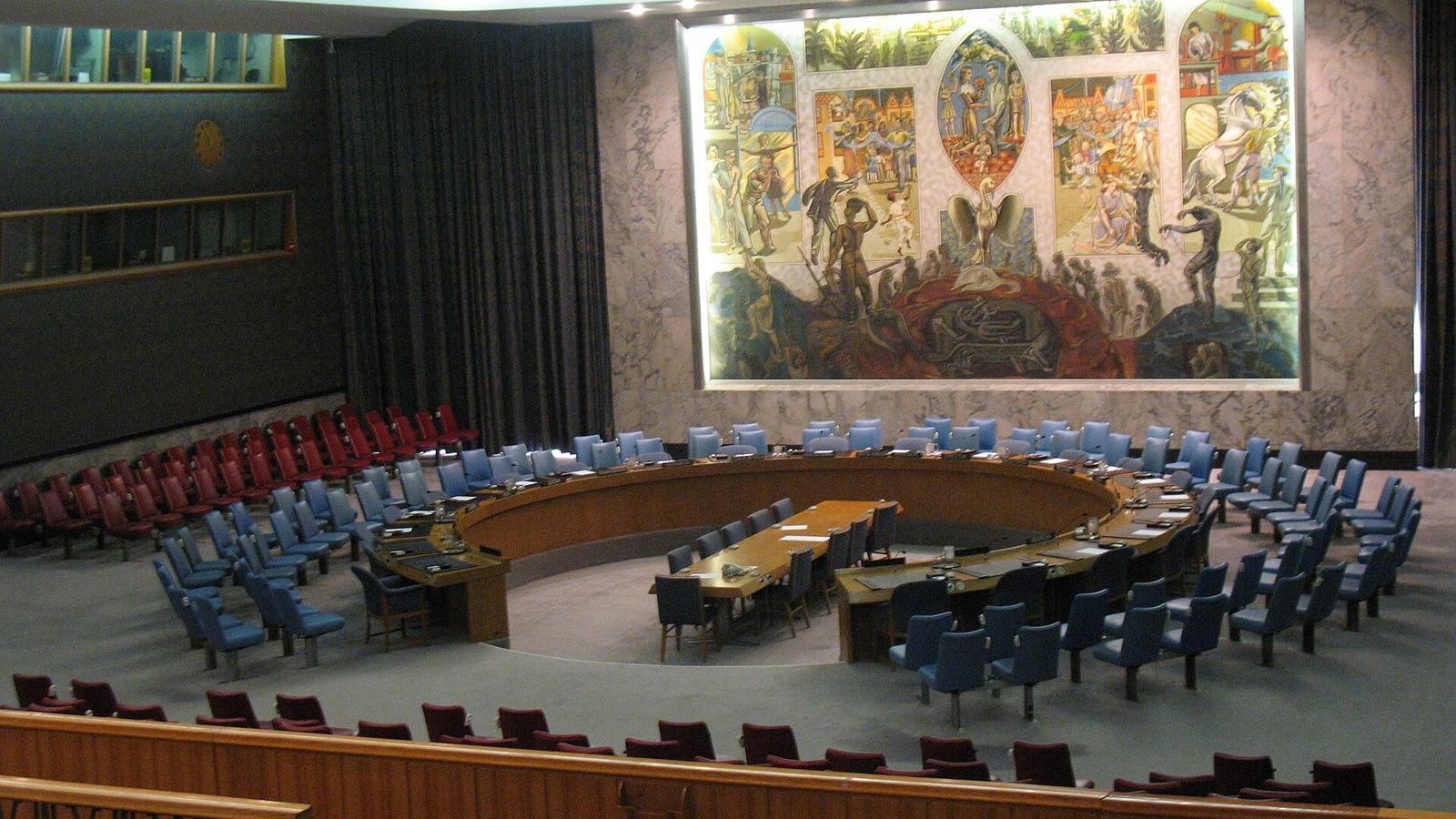
The United Nations Security Council has five permanent members with a veto and ten elected members without one; a resolution needs nine votes including all five permanent members. Under the Shapley-Shubik index each permanent member holds about 19.6 per cent of the power and each elected member about 0.2 per cent, so the five hold about 98 per cent between them. The voting rules are published by the Council itself.
The Council of the European Union has decided by qualified majority since 1 November 2014 under a double rule: a proposal passes with at least 55 per cent of the member states representing at least 65 per cent of the Union's population. The population half of the rule gives the large states more weight, and power indices computed from the population figures show that power rises with population, though less than proportionally. Lionel Penrose had argued in 1946 that in a two-tier system of this kind a member's weight should grow with the square root of its population if every citizen is to have equal influence, and the square-root rule was debated at length when the Union's rules were negotiated. The design of such rules is one of the places where the indices stopped being descriptions and became tools.
What the indices do not measure
A power index counts coalitions as if all were equally likely to form. In a real council some members never vote together, and a member's actual influence depends on where she stands relative to the others on the questions that come up. The indices are therefore best read as a measure of the voting rule itself, independent of the politics: what the rule gives each seat before anyone sits down. On that question they are the right tool, and they show, again and again, that a rule written in terms of weights distributes power in ways its authors did not intend.
Unit 12 of the Game Theory Masterclass defines both indices, computes them on the games above and on the Nassau County board, lets you compute the Security Council and the Council of the European Union with its interactive, and shows that the Shapley value behind the second index is the same formula that now explains the predictions of machine learning models.