Game Theory Masterclass 12-Week Program in Game Theory

Study how people, firms, nations, and animals decide when the outcome depends on what others do, one unit per week, with worked games and the research of game theorists who are working today.

  • Certificate
  • Online
  • Join a community of 2000+
Entry game as a game tree. The entrant chooses Stay out, with payoffs 0 for the entrant and 3 for the incumbent, or Enter. After entry the incumbent chooses Fight, payoffs minus 1 and minus 1, or Accommodate, payoffs 2 and 1.EntrantIncumbentStay outEnterFightAccommodate(0, 3)(−1, −1)(2, 1) Entry game as a game tree, drawn downward. The entrant chooses Stay out, with payoffs 0 for the entrant and 3 for the incumbent, or Enter. After entry the incumbent chooses Fight, payoffs minus 1 and minus 1, or Accommodate, payoffs 2 and 1.EntrantIncumbentStay outEnterFightAccommodate(0, 3)(−1, −1)(2, 1)

The entry game. Payoffs are written (entrant, incumbent).

  1. Not credible: fighting gives the incumbent −1 instead of 1.
  2. So entering gives the entrant 2 instead of 0.
  3. Subgame perfect equilibrium (2, 1).

Our alumni study at

  • Massachusetts Institute of Technology
  • Harvard University
  • Stanford University
  • California Institute of Technology
  • Princeton University
  • University of Oxford
  • ETH Zurich
  • Imperial College London
  • University of California, Berkeley
  • University of Chicago
  • Yale University
  • Columbia University
  • Technical University of Munich
  • University of Toronto
  • University of Tokyo
  • EPFL

About the program

The Game Theory Masterclass takes you through game theory one unit at a time. You enrol, and from then on a new unit reaches you every week. Each unit is a chapter written for this program, with payoff matrices and game trees worked out step by step, proofs you can follow line by line, and the published research of game theorists who are active today.

A quiz completes every unit and opens the next. At the end you sit a final exam and receive a certificate with a public verification page.

What the program is like
StructuredA fixed sequence of units that starts with a two by two payoff matrix and ends with the auctions and matching markets designed by game theorists.
Demanding and fairEvery equilibrium is computed in full, and every proof comes with a worked example you can check by hand.
RecognizedA certificate and a transcript, both with a verification ID that anyone can check online.

Curriculum

All sixteen units lie on one path. Foundation ends after Unit 8, Advanced after Unit 12, and Advanced + Market Design after Unit 16. Select a unit to read what it covers.

  1. 1 Players, Strategies, and Payoffs
  2. 2 Dominant Strategies and the Prisoner's Dilemma
  3. 3 Nash Equilibrium
  4. 4 Mixed Strategies and the Minimax Theorem
  5. 5 Game Trees and Backward Induction
  6. 6 Repeated Games and Cooperation
  7. 7 Bargaining and Fair Division
  8. 8 The Reach of Game Theory
  9. Foundation 8 units, 8 weeks
  10. 9 Incomplete Information and Bayesian Games
  11. 10 Signalling and Screening
  12. 11 Evolution and Stable Strategies
  13. 12 Coalitions, Power, and Voting
  14. Advanced 12 units, 12 weeks
  15. 13 Auction Theory
  16. 14 Mechanism Design and Truthful Rules
  17. 15 Stable Matching and Kidney Exchange
  18. 16 Spectrum Auctions and Online Advertising
  19. Advanced + Market Design 16 units, 16 weeks

Unit 1. Players, Strategies, and Payoffs. A game in the technical sense is a situation in which each person's outcome depends on what the others do. The unit builds the toolkit of the whole program: players, strategies, and payoffs, the payoff matrix and how to read it, simultaneous and sequential moves and the game tree, the expected value of a payoff when the other player's move is uncertain, and best responses as the first solution idea. It closes with the size of chess and Go and why solution concepts rather than brute force are needed. About this unit

Full curriculum with every unit page

John von Neumann in a suit and tie, the official Los Alamos portrait photograph.
John von Neumann proved the minimax theorem in 1928. Unit 4 states it and shows how to compute the mixing probabilities. Photo: Los Alamos National Laboratory, Wikimedia Commons, attribution.
President Kennedy at the cabinet table with the members of the Executive Committee of the National Security Council during the Cuban missile crisis.
President Kennedy with the Executive Committee of the National Security Council, 29 October 1962. Credible and empty threats are the subject of Unit 5, the same reasoning that prunes the entry game above. Photo: Cecil Stoughton, White House, Wikimedia Commons, public domain.

Who is this program for?

High School Students

You like puzzles, chess, or mathematics and want to know why people cooperate, bluff, and bargain. The masterclass gives you a head start for economics, mathematics, or computer science.

  • School mathematics is enough
  • Certificate for applications
  • Theory for olympiads and competitions

University Students

You study economics, mathematics, computer science, politics, or biology, and game theory keeps appearing. Use the masterclass alongside your degree or as the base of a first project.

  • Proofs and fully worked games
  • Current research papers
  • A tool of the field every week

Lifelong Learners

You negotiate contracts, play poker or Go, or follow international politics. The masterclass explains strategic reasoning step by step, with the games game theorists actually use.

  • No deadlines, pause any time
  • Unit 1 refreshes the mathematics
  • Read on screen or as PDF

How does it work?

  1. Step 1: Enrol

    Create your account with your email address, choose your masterclass, and pay the Tuition Fee. Your program starts at once.

  2. Step 2: Receive your unit

    Unit 1 arrives immediately and every further unit on a Monday, as a web page and as a PDF to keep.

  3. Step 3: Study

    Work through the games, the worked examples, and the proofs, and answer the questions in the text as you go. A day later we send further reading, including research papers that are free to read.

  4. Step 4: Take a quiz for every unit

    Each unit has its own quiz: ten questions, open book, no time limit. You submit it before the next unit is sent to you.

  5. Step 5: Sit the final exam

    50 questions across the units of your masterclass in 60 minutes, open book. You pass with 70% and have up to 3 attempts.

  6. Step 6: Earn your certificate

    Certificate and transcript as PDF, each with a verification ID and a personal link you can share.

Research presented in the program

Every unit has a research spotlight on the published work of a game theorist who is active today, explained at your level and linked to the original paper.

The scientists named here are not contributors to the Game Theory Masterclass, are not affiliated with it, and have not endorsed it. The program presents and explains their published research, with references to the original papers.

All research spotlights

Tuition Fee

Choose the masterclass that fits you. One Tuition Fee, paid once, covers every unit, quiz, the final exam, and your certificate.

8 weeks

Foundation

The fundamentals of game theory: dominance, equilibrium, mixing, game trees, repeated games, and bargaining.

Tuition Fee$35$39
Enrol in Foundation
  • 8 weekly units as web page and PDF
  • Quiz and further reading for every unit
  • Final exam, certificate, and transcript
Topics in this program
  1. 01
    Players, Strategies, and Payoffs
  2. 02
    Dominant Strategies and the Prisoner's Dilemma
  3. 03
    Nash Equilibrium
  4. 04
    Mixed Strategies and the Minimax Theorem
  5. 05
    Game Trees and Backward Induction
  6. 06
    Repeated Games and Cooperation
  7. 07
    Bargaining and Fair Division
  8. 08
    The Reach of Game Theory
  9. 09
    Incomplete Information and Bayesian Games
  10. 10
    Signalling and Screening
  11. 11
    Evolution and Stable Strategies
  12. 12
    Coalitions, Power, and Voting
  13. 13
    Market DesignAuction Theory
  14. 14
    Market DesignMechanism Design and Truthful Rules
  15. 15
    Market DesignStable Matching and Kidney Exchange
  16. 16
    Market DesignSpectrum Auctions and Online Advertising
16 weeks

Advanced + Market Design

The full program plus four units on market design: auctions, truthful mechanisms, matching, and the markets that run today.

Tuition Fee$85$119
Enrol in Advanced + Market Design
  • 16 weekly units as web page and PDF
  • Quiz and further reading for every unit
  • Final exam, certificate, and transcript
Topics in this program
  1. 01
    Players, Strategies, and Payoffs
  2. 02
    Dominant Strategies and the Prisoner's Dilemma
  3. 03
    Nash Equilibrium
  4. 04
    Mixed Strategies and the Minimax Theorem
  5. 05
    Game Trees and Backward Induction
  6. 06
    Repeated Games and Cooperation
  7. 07
    Bargaining and Fair Division
  8. 08
    The Reach of Game Theory
  9. 09
    Incomplete Information and Bayesian Games
  10. 10
    Signalling and Screening
  11. 11
    Evolution and Stable Strategies
  12. 12
    Coalitions, Power, and Voting
  13. 13
    Market DesignAuction Theory
  14. 14
    Market DesignMechanism Design and Truthful Rules
  15. 15
    Market DesignStable Matching and Kidney Exchange
  16. 16
    Market DesignSpectrum Auctions and Online Advertising

Tuition fees are one-time payments and include applicable taxes. Secure payment by card through Stripe.

Your certificate

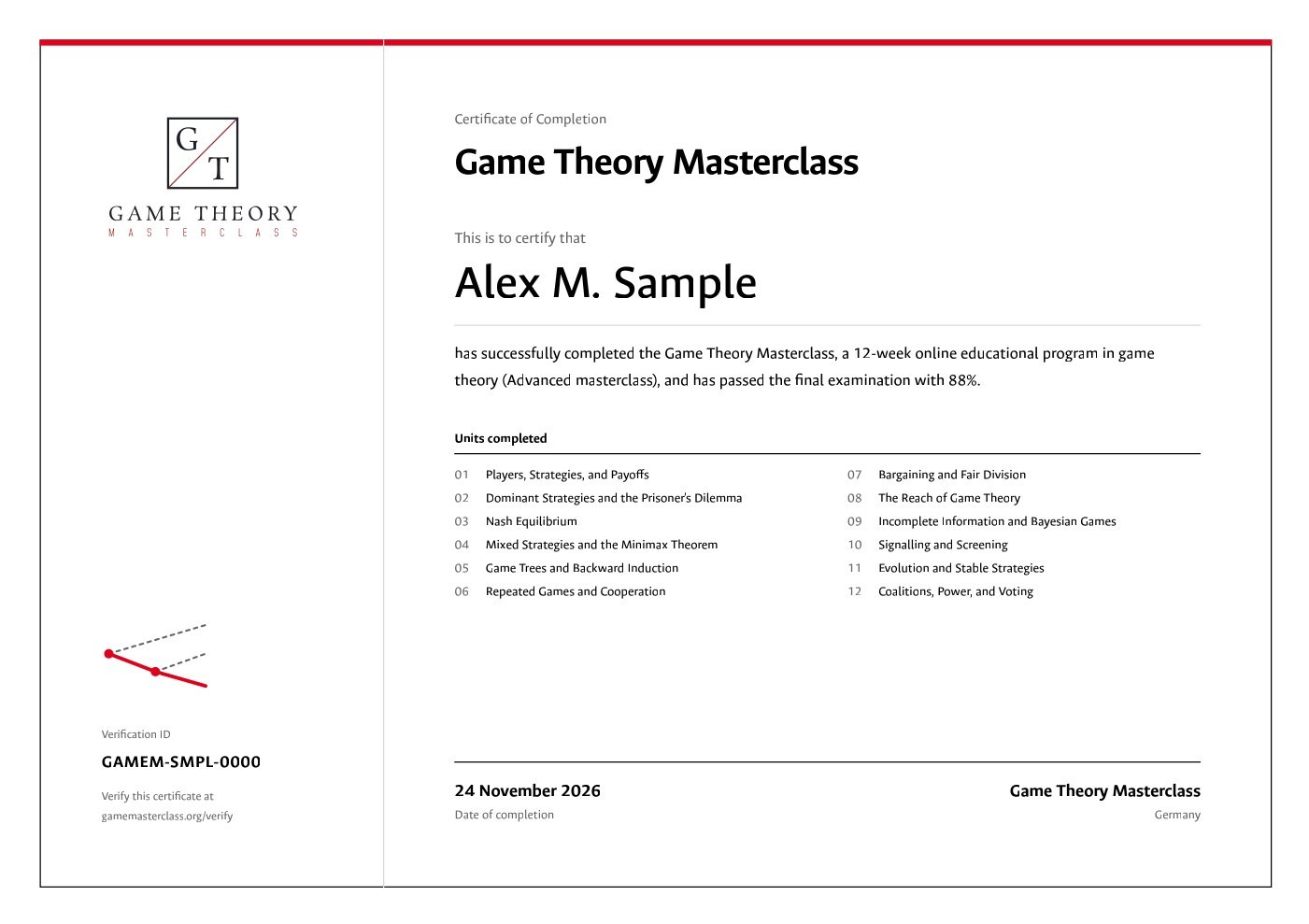
Sample certificate of completion of the Game Theory Masterclass

Participants who pass the final exam receive an official certificate of completion. It states your name, the masterclass, its duration, and the units you completed.

What the certificate gives you
Certificate and transcriptThe transcript lists your score in every unit quiz and in the final exam.
VerifiableBoth documents carry a verification ID that can be checked on this website.
ShareableYour personal verification link shows your result to universities, scholarship committees, and employers.

Sample unit

First page of Unit 3: Nash Equilibrium

Unit 3. Nash Equilibrium

16 pages, as web page and PDF

Most games have no dominant strategies, so a stable prediction needs another idea. A Nash equilibrium is a profile in which every player's strategy is a best response to the others. The unit finds every pure equilibrium of the stag hunt, the coordination game with conflicting preferences, and chicken by underlining, explains how focal points, conventions, and risk dominance select among several equilibria, and solves Cournot's model of two competing producers with the program's numbers, against the monopoly and the competitive outcome and against Bertrand's price competition. It closes with Nash's existence theorem and the question whether an equilibrium can be computed quickly.

Opening questions

  1. What is a Nash equilibrium, and in what sense is it a stable outcome?
  2. How do I find every pure strategy equilibrium of a matrix game?
  3. Why does the stag hunt have two equilibria, and what decides which one is played?
  4. How do two competing producers choose their quantities in Cournot's model, and why do they produce more than a monopolist and less than competitive firms?
  5. Why does price competition between two identical firms drive the price down to cost?

Academic community

Masterclass participants come from all over the world, and when you complete the program you stay part of a network that keeps you close to game theory.

Game theorists in our community
2000+
Countries represented
90+
Schools and universities represented
300+

What participants say

  • I thought I knew the prisoner's dilemma from a video. Unit 2 made me write the matrix with the numbers 5, 3, 1, and 0, underline the best responses, and see that both players defect whatever the other does. Two months later I used the same underlining on a coordination question in our economics olympiad round.

    Aditya K., High school student, India12 September 2026

  • I expected to let Nashpy do the work. Computing the mixed equilibrium of matching pennies by hand in Unit 4, and then checking that both expected payoffs come out equal, told me what the solver actually does. The minimax proof for the 2 by 2 case took me two readings and was worth both.

    Lucas B., Computer science undergraduate, TU Delft, Netherlands20 August 2026

  • I run tenders for a living and had never seen the second-price auction argument written down. Unit 13 shows in half a page why bidding your value is dominant there and why it is not in a first-price auction, and the worked example with uniform values is the clearest thing I have read on bid shading. I scored 8 out of 10 on that quiz and understood from the explanations what I had missed.

    Margaret O., Procurement manager, Ireland8 July 2026

After the program

  • Game-Connect

    Our alumni program introduces former participants to one another across countries: for study advice, exchange about university applications, and shared projects.

  • Opportunities

    Past participants hear from us about scholarships, competitions, summer schools, and other academic opportunities in economics, mathematics, computer science, and related fields.

  • A place in research

    The program shows you how game theorists work and where their research happens, so that your next step at school, at university, or at work is an informed one.

The academic community  ·  More testimonials

From the blog

  • Where game theorists work

    Spectrum auctions, advertising platforms, competition authorities, hospitals, ecology departments, and poker-playing programs all employ people who learned game theory. What each of them asks of a student, and which degree gets you there.

  • How to prepare for the game theory questions of the economics olympiad

    The International Economics Olympiad lists four game theory items in its syllabus. Here is what each one asks, which classic games to practise with, where the past papers are, and how the mathematical olympiads differ.

  • The auction that moved television to make room for mobile phones

    Between March 2016 and April 2017 the United States bought television channels from broadcasters and sold the freed airwaves to mobile operators in a single auction. Here is how a descending clock, four stages, and a satisfiability solver did it.

All articles

Frequently asked questions

Who is this program for?

For high school students, university students, and lifelong learners. High school students use it to understand why people cooperate, bluff, and bargain the way they do, to get ahead before a degree in economics, mathematics, or computer science, and to prepare for the game theory questions of the International Economics Olympiad and the game problems of the mathematical olympiads. University students in economics, mathematics, computer science, politics, or biology take it next to their degree, before or during a first course in microeconomics, algorithms, or evolutionary biology. Lifelong learners, among them people who negotiate contracts, play poker or Go, or follow international politics, use it to see the games behind what they do and watch. The Foundation masterclass suits a first contact with the subject; the Advanced masterclass goes on to hidden information, signalling, evolution, and coalitions.

What do I need to know before I start?

School mathematics is enough: fractions and percentages, linear and simultaneous equations, the graph of a straight line, and reading a table. You do not need any prior knowledge of economics, probability, or game theory. Unit 1 teaches every tool the later units use, including how to read a payoff matrix and a game tree, what a strategy is, probability as a number between 0 and 1, and expected value as a weighted average. There is no calculus in the first eight units: the Cournot equilibrium is found by completing the square and the mixing probabilities by solving a linear equation. From Unit 9 on, a derivative may appear inside a box marked as a proof, with every step explained in words; the main text never depends on it. No unit requires a spreadsheet, a programming language, or a particular calculator.

How much time do I need each week, and are there live sessions?

Most participants spend three to five hours a week: two or three hours on the unit, under an hour on the open-book quiz, and the rest on the further reading if they want it. Units with long worked games, such as the ones on mixed strategies, Bayesian games, and auctions, take more if you redo the computations yourself, which we recommend, because in game theory almost everything can be checked by hand. The program is fully online and has no live sessions, so it works in every time zone and next to school, university, or work. You receive the units by email and read them on the website or as PDF. Quizzes and the final exam are taken on the website.

Can I finish the program in less than 12 weeks?

Yes. A new unit is scheduled for every Monday, but once you have submitted the quiz of a unit you can ask for the next one ahead of schedule, from your dashboard or from the email we send you. The earliest moment is 24 hours after the previous unit was sent. We recommend the weekly rhythm, because the material needs time to settle, but the pace is your decision.

What happens if I fall behind or have to pause?

Nothing is lost. The next unit is only sent once you have submitted the quiz of the current one, so the program waits for you. You can pause for a week or for a term and continue at any time. There is no penalty and no deadline.

How does the final exam work?

After the last unit you sit the final exam online: 50 multiple-choice questions across all units of your masterclass, drawn individually for each participant, with a time limit of 60 minutes. It is open book, and the Key Results and Equilibria page is the sheet to have open. You pass with 70% correct answers. If you do not pass, you can try again after 3 days with new questions, up to 3 attempts in total.

All questions

Stay up to date

New program dates, offers, and the occasional article about strategy, bargaining, and the people who study them. You can unsubscribe at any time.

Email address

Begin your 12 weeks of game theory

(0, 3) (−1, −1) (2, 1)