

Game Trees and Backward Induction
When players move one after another, the game is a tree, and the way to solve it is to start at the last move and reason backwards. The unit sets out the extensive form with its information sets, states Zermelo's theorem about chess and the open problem it leaves, separates credible from empty threats in the entry game, and defines subgame perfect equilibrium with the one-deviation principle as its practical test. It derives Stackelberg's first-mover advantage with the program's Cournot numbers, explains commitment through the Cuban missile crisis as historians date it, and examines the ultimatum and centipede games, where people depart from backward induction.
Unit 1 wrote the entry game down twice, once as a tree and once as a matrix, and ended with a promise: the order of the moves changes the answer. This unit keeps that promise. When players move one after another and see what has been done before them, the natural way to solve the game is to start at its last move and reason backwards. That one procedure settles chess in principle, exposes threats that nobody would carry out, explains why moving first in a market can be worth money, and produces two laboratory results, repeated hundreds of times since the 1980s, in which people refuse to do what the procedure recommends.
1 Trees, information, and strategies
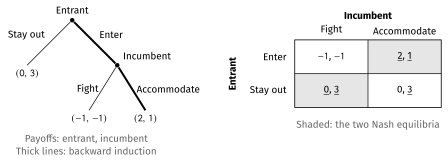
Unit 1 drew a game tree informally. The precise version is called the extensive form of a game. It consists of a tree that starts at a single node, the root, and branches out. Every node that is not an end point carries the name of the player who moves there and one branch for each action available to that player; every end point, which is called a terminal node, carries one payoff for each player, written in the players’ order; and where the game has chance moves, such as the deal of a hand of cards, an extra player called nature moves, whose branches carry probabilities instead of being chosen. A play of the game is a path from the root to a terminal node. Figure 1 shows the entry game of Unit 1 in this form: the entrant moves at the root, the incumbent moves at the node after an entry, and the three terminal nodes carry the payoffs, entrant first.
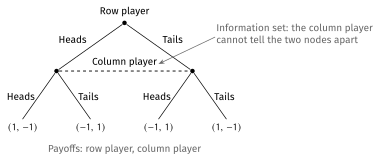
In the entry game the incumbent, when it moves, knows that the entrant has entered. Chess is like that too, and so is every board game in which both players see the board. A game in which every player, at every one of their moves, knows every move made before is a game of perfect information. Many games are not. In poker a player does not know the other players’ cards, and in a sealed-bid auction nobody knows the other bids. The extensive form records this with information sets. An information set is a set of nodes, all belonging to the same player, which that player cannot tell apart when it is their turn. The nodes of an information set are joined by a dashed line, and because the player cannot tell them apart, the same actions must be available at all of them and the player’s choice must be the same at all of them. A game with at least one information set of two or more nodes is a game of imperfect information.
With this device the simultaneous games of Units 2 to 4 can be drawn as trees as well. Figure 2 draws matching pennies, the game of Unit 1 in which the row player wins when the two coins match, and which Unit 3 found to have no equilibrium in pure strategies. In the drawing the row player moves first, and the column player moves at two nodes joined by a dashed line, one for each side of the row player’s coin. The dashed line says that the column player does not know which of the two nodes has been reached, which is exactly what it means to choose at the same time. The matrix of Unit 1 and the tree of Figure 2 describe one and the same game, and the choice between the two pictures is a matter of convenience. A tree with dashed lines is the more general picture, and the procedure of Section 2 needs the dashed lines to be absent.
1.1 Strategies as plans
Unit 1 defined a strategy of a sequential game as a complete plan: a rule that names one action at every node where the player moves, including nodes that the plan itself makes unreachable, and it showed that a player with \(m\) decision nodes and \(a_1, \ldots, a_m\) actions at them has \(a_1 \times \cdots \times a_m\) strategies. In a game of imperfect information a plan names one action for each information set, since the player cannot condition on what they cannot see. From here on two words are kept carefully apart, action and strategy. An action is what a player does at one node, such as “accommodate”; a strategy is a list of actions, one for every node of the player, such as “accommodate a large entrant and fight a small one”. The matrix of a game has one row or column per strategy, never per action, which is why the matrix of even a small tree can be large.