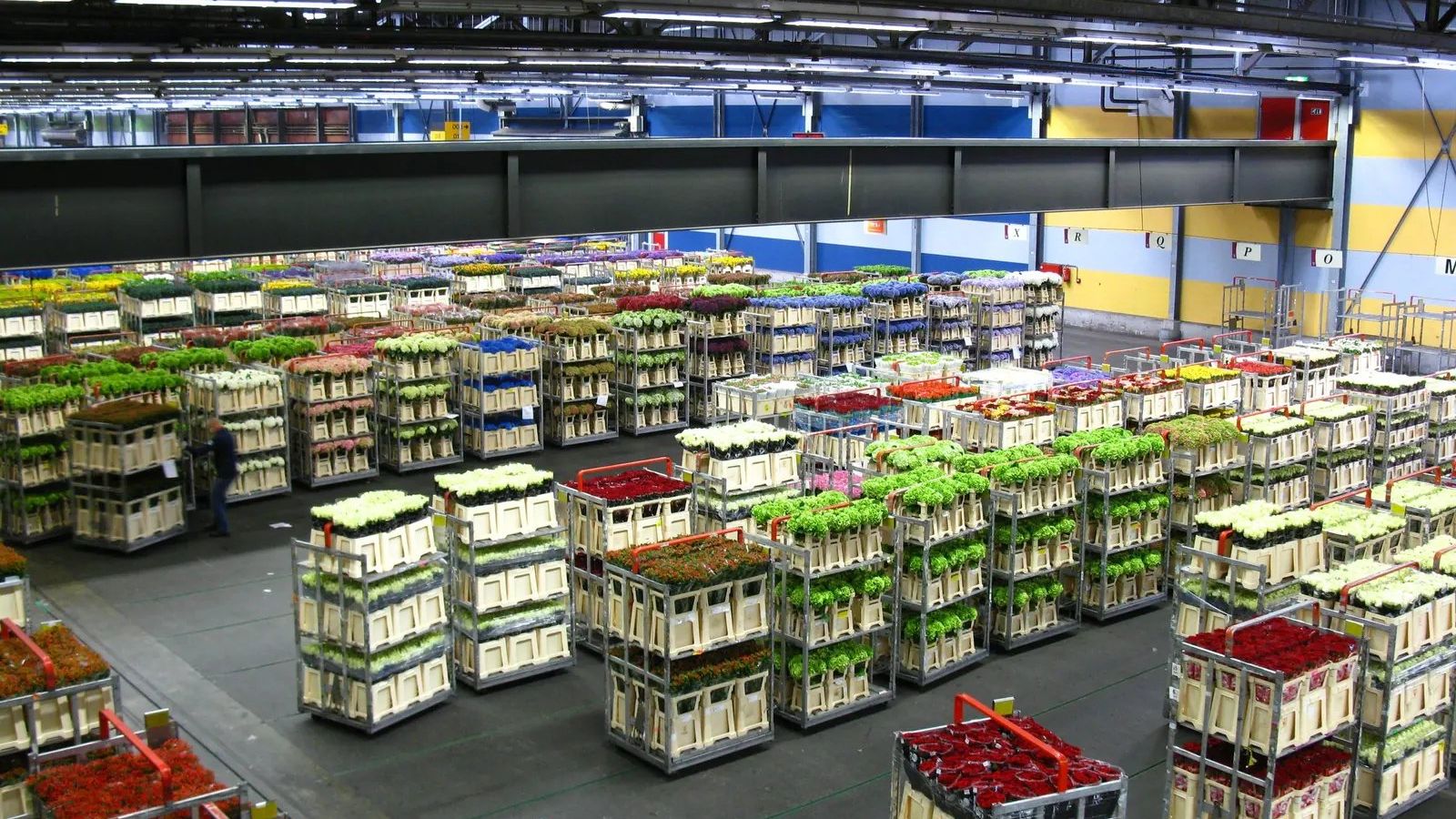
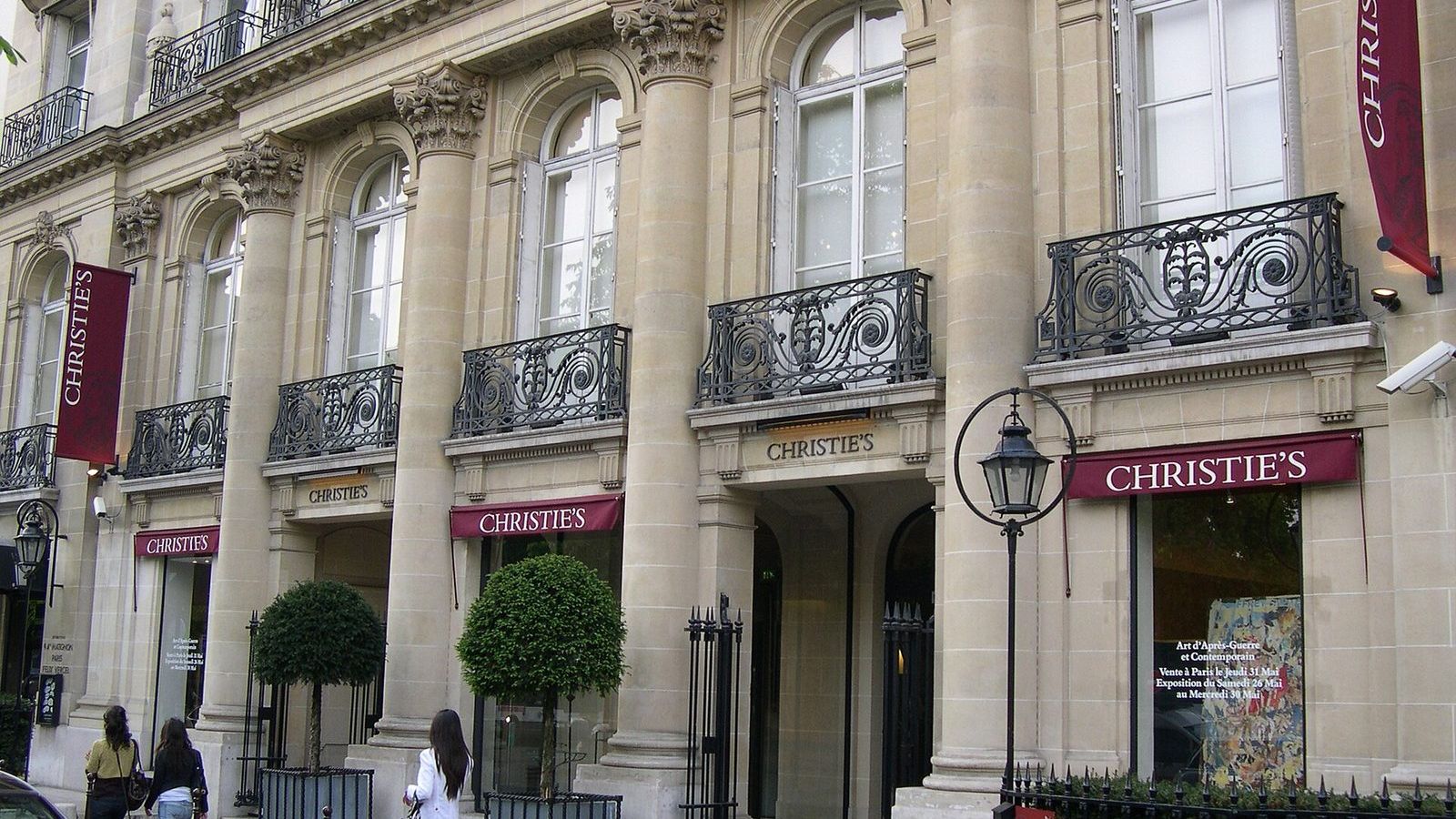
 Image: Tilo 2007, CC BY-SA 2.0
Bidding in a second-price auction
You are bidding for a painting in a sealed-bid auction. Everyone writes a number on a slip, the highest number wins, and the winner pays the second-highest bid rather than her own. The painting is worth 1,000 euros to you, meaning you would be exactly indifferent between having it and having 1,000 euros. What should you write?
The answer is 1,000, and it does not depend on how many other bidders there are, what you think they will bid, or whether they are bidding sensibly. Bidding your value is a dominant strategy. William Vickrey proved it in a paper in the Journal of Finance in 1961, and the auction is named after him.
Vickrey's argument
Call your value \(v\) and the highest of the other bids \(b\). You do not know \(b\), but whatever it is, one of three things is true.
If \(b < v\), a bid of \(v\) wins and you pay \(b\), for a gain of \(v - b > 0\). Any other bid above \(b\) wins the same object at the same price \(b\), so it does no better. A bid below \(b\) loses and gains nothing, so it does worse. Bidding \(v\) is at least as good as anything else.
If \(b > v\), a bid of \(v\) loses and you gain nothing. Any bid below \(b\) also loses. A bid above \(b\) wins, but you then pay \(b\), which is more than the object is worth to you, for a loss. Again bidding \(v\) is at least as good as anything else.
If \(b = v\), you are indifferent between winning at price \(v\) and losing, and bidding \(v\) gives one of the two.
In every case bidding your value is at least as good as any other bid, and in some cases strictly better. That is the definition of a weakly dominant strategy, and the argument never used a probability, a belief, or an assumption about anyone else. The price you pay is set by the others; your bid only decides whether you win. Once you see that, there is no reason to shade.
Why the first-price auction is different
In a sealed first-price auction the winner pays her own bid, and bidding your value is now a mistake: you would win and gain nothing. You must bid less, and how much less depends on the others. Bid very low and you rarely win; bid close to your value and you win often but gain little. With \(n\) bidders whose values are independent and uniformly distributed, the equilibrium bid is
\[ b(v) = \frac{n - 1}{n}\, v, \]so two bidders each bid half their value, five bidders bid four fifths, and the shading shrinks as competition grows. The first-price auction is a game in which your best bid depends on your beliefs about the others; the second-price auction is one in which it does not. Vickrey also showed that the two formats raise the same revenue on average when bidders are risk neutral and their values are independent draws from the same distribution: what the winner saves by paying the second-highest bid in one format she gives up by shading in the other. That is the revenue equivalence theorem, and its assumptions are where most of the later auction theory lives.
Two auctions you already know
An English auction, with an auctioneer calling rising prices until one bidder is left, is strategically the same as a second-price sealed-bid auction when each bidder knows her own value: you stay in until the price reaches your value and drop out, and the winner pays roughly the value of the second-to-last bidder. The Dutch auction, with a clock falling from a high price until someone stops it, is the same as the first-price auction, because stopping the clock at a price is the same as having bid that price in a sealed envelope.
Proxy bidding on online auction sites is a Vickrey auction in disguise. You tell the site the most you are willing to pay, it bids on your behalf just enough to stay ahead, and if you win you pay a small increment above the second-highest maximum. The site's own advice, to enter the most you are willing to pay and leave it, is Vickrey's theorem in plain words.
The stamp dealers
Vickrey's paper is usually dated as the origin of the auction, but David Lucking-Reiley showed in a 2000 article in the Journal of Economic Perspectives that stamp collectors had been using it since the 1890s. Dealers selling stamps by mail invited bids by post, awarded the lot to the highest bidder, and charged a small step above the second-highest bid, and they explained in their catalogues why this let a distant bidder simply state the most she would pay. Philatelic societies ran such auctions for decades, and the practice spread to other collectibles before economists noticed it. Vickrey's contribution was not the rule but the proof of what the rule achieves, and the comparison with the other formats.
The limits
The theorem is about one object and private values, where each bidder knows what the object is worth to her. If the object has a common value that nobody knows exactly, an oil tract or a jar of coins, then the bidder with the highest estimate is the one who most overestimated it, and bidding your estimate leads to the winner's curse; the correct bid is lower in every format. If several identical objects are sold at once and bidders want more than one, the generalization of Vickrey's auction is more complicated, and the simple rule that each winner pays the highest losing bid is no longer truthful. And a second-price auction is vulnerable to a seller who inserts a fake bid just under the winner's, which is one reason the format is rarer in practice than its theoretical appeal suggests.
Vickrey received the Nobel prize in economic sciences in 1996, with James Mirrlees, for work on incentives under asymmetric information. The announcement came on 8 October; he died three days later, on his way to a conference. The 1961 paper is the start of auction theory, the first result in what became mechanism design, and the first thing a student of the subject should be able to prove on a blank sheet of paper.
Unit 13 of the Game Theory Masterclass proves Vickrey's theorem by the case analysis above, derives the first-price bid by guess and verify, checks revenue equivalence for two and three bidders, and works the coin jar to show the winner's curse. Unit 14 shows that the second-price auction is a special case of a far more general truthful mechanism.