 Image: Voltmetro, CC BY-SA 4.0
Penalty kicks and the minimax theorem
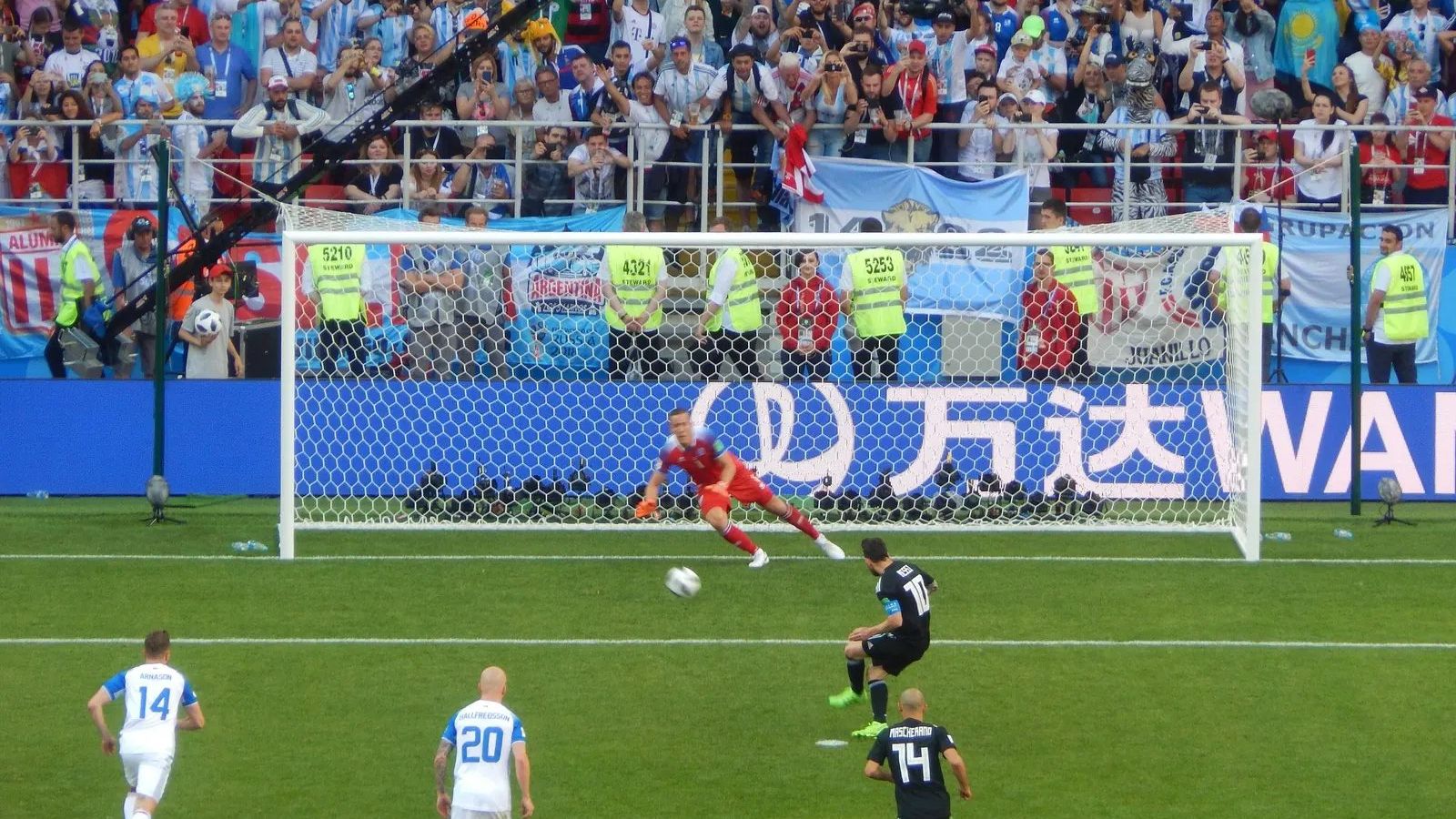
A penalty kick lasts less than half a second from the strike of the ball to the goal line, which is too short for the goalkeeper to react to the direction of the shot. Both players therefore commit at the same moment: the kicker picks a side, the goalkeeper picks a side, and the outcome depends on the pair. A goal for the kicker is exactly a non-goal for the goalkeeper. That makes the penalty a two-player zero-sum game with simultaneous moves, and such games are the ones for which game theory has its oldest and sharpest result.
The game
Simplify to two actions each: the kicker shoots to his natural side or to the other side, and the goalkeeper dives to the kicker's natural side or to the other. For a right-footed kicker the natural side is the goalkeeper's right. The payoff is the probability that the kick scores. Shots are not always on target and goalkeepers do not always save even when they guess right, so all four probabilities lie strictly between 0 and 1. Rounded, the professional numbers look roughly like this: when both go to the natural side the kick scores about 58 per cent of the time; when the kicker goes natural and the goalkeeper the other way, about 95 per cent; when the kicker goes to the other side and the goalkeeper to the natural side, about 93 per cent; and when both go to the other side, about 70 per cent.
| Scoring probability | Goalkeeper dives natural | Goalkeeper dives other |
|---|---|---|
| Kicker shoots natural | 0.58 | 0.95 |
| Kicker shoots other | 0.93 | 0.70 |
Read the table as the kicker. If the goalkeeper always dived to the natural side, you would always shoot to the other side and score 93 per cent of the time. But then the goalkeeper would dive the other way, and you would want to switch back. There is no pair of pure choices at which neither player wants to change, so the game has no equilibrium in pure strategies. The way out is to randomize.
Mixing and indifference
Let the kicker shoot to the natural side with probability \(p\) and the goalkeeper dive to the natural side with probability \(q\). The kicker's expected scoring probability from shooting natural is \(0.58 q + 0.95 (1 - q)\), and from shooting to the other side it is \(0.93 q + 0.70 (1 - q)\). If one of these were larger, the kicker would always choose it, and the goalkeeper could exploit that. In equilibrium the goalkeeper's \(q\) must make the kicker indifferent:
\[ 0.58 q + 0.95 (1 - q) = 0.93 q + 0.70 (1 - q), \]which gives \(q = 0.25 / 0.60 \approx 0.42\). The same argument for the goalkeeper, who wants the kicker indifferent between his two sides, gives \(p \approx 0.39\). So the theory predicts that this kicker should shoot to his natural side about 39 per cent of the time and the goalkeeper should dive there about 42 per cent of the time, and that at these frequencies the kick scores about 80 per cent of the time whichever way the kicker shoots.
The number 80 per cent is the value of the game. John von Neumann proved in 1928 that every finite two-player zero-sum game has such a value: an amount the first player can guarantee on average whatever the second does, and which the second can hold the first to whatever the first does. The theorem is called the minimax theorem because the guaranteed amount is the maximum over the first player's mixes of the minimum over the second player's responses, and this equals the minimum over the second player's mixes of the maximum over the first's. Unit 4 of the masterclass proves it for 2 by 2 games in full and states it in general.
Notice something odd about the calculation. The kicker's probability \(p\) was found from the condition that the goalkeeper is indifferent, so it depends on the goalkeeper's payoffs, which here are the same numbers seen from the other side. Change how good the kicker is at shooting to his weak side, and it is the goalkeeper's diving frequency that changes, not the kicker's shooting frequency. Students meet this result with disbelief, and it is correct.
Two predictions and 1,417 kicks
The equilibrium makes two claims that can be checked against data. First, a player who mixes correctly scores (or concedes) at the same rate whichever action he takes, because indifference is what the mix produces. Second, the sequence of a player's choices should look random: a kicker who alternates, or who shoots left after two rights, is predictable and can be exploited.
Ignacio Palacios-Huerta, then at Brown University and later at the London School of Economics, collected 1,417 penalty kicks from professional league matches in Spain, Italy, England, and elsewhere between 1995 and 2000, recorded the foot of the kicker, the side of the shot, the side of the dive, and the outcome, and tested both predictions kick by kick and player by player. His paper Professionals Play Minimax appeared in the Review of Economic Studies in 2003. Both predictions held. Kickers scored at statistically the same rate on their natural and their other side; goalkeepers conceded at the same rate on both; and the sequences of choices by the players with enough kicks in the data passed the standard tests for serial independence. The observed frequencies were within a couple of percentage points of the frequencies computed from the scoring rates.
This was a surprise, because laboratory subjects asked to play matching pennies for money generally fail the second test. People are bad at producing random sequences; they switch too often. Professional footballers, who have taken hundreds of penalties under pressure with a lot at stake, behave as the theory says.
What the result does not say
The result does not say that footballers compute indifference conditions, any more than a dog catching a ball solves differential equations. Players who were exploitable would have been exploited, and over years of professional play the habits that survive are the ones that cannot be. Nor does it say that every choice in football is optimal. Michael Bar-Eli and colleagues analysed 286 penalties in 2007 and found that goalkeepers dive left or right in about 94 per cent of kicks although staying in the centre would have saved more of them; a goalkeeper who stays put and concedes looks worse than one who dives and concedes, and that may be part of the payoff. The minimax prediction concerns the mix over the actions a player actually uses, and within those actions the professionals mix correctly.
The same structure appears wherever two parties want to be unpredictable: a tax authority deciding whom to audit, a tennis player choosing where to serve, a penalty taker, a poker player deciding when to bluff. Unit 4 of the Game Theory Masterclass builds the penalty kick game from the published scoring rates, computes both mixes, and compares them with the observed frequencies; Unit 9 takes the same indifference argument into poker, where it explains why bluffing is part of good play.