 Image: Greg Schechter, CC BY 2.0
Hawks, doves, and the lizards that play rock, paper, scissors
Male red deer roar at each other, walk in parallel, lock antlers, and push. One of them usually gives up before anyone is seriously hurt, although both carry weapons that could kill. Charles Darwin had noticed that fights between animals of the same species are mostly displays, and the usual explanation in the 1960s was that restraint was good for the species. John Maynard Smith, a geneticist at the University of Sussex who had trained as an aircraft engineer, did not accept that: selection acts on individuals, and an individual who fought all out against a restrained opponent would win every contest and leave more offspring. In 1973, with George Price, he published "The Logic of Animal Conflict" in Nature and answered the question with a game.
The hawk-dove game
Two animals contest a resource worth \(V\) in units of fitness, say extra offspring. Each plays one of two strategies. A hawk escalates until it wins or is injured; a dove displays and retreats if the opponent escalates. When a hawk meets a dove, the hawk takes the resource and the dove leaves with nothing. When two doves meet, they display until one gives up, and on average each gets half: \(V/2\). When two hawks meet, one wins the resource and the other is injured at a cost \(C\); each has an even chance of either, so the expected payoff is \((V - C)/2\).
Take \(V = 4\) and \(C = 6\), the numbers the Game Theory Masterclass uses throughout. The row player's payoffs are then: hawk against hawk \(-1\), hawk against dove \(4\), dove against hawk \(0\), dove against dove \(2\).
| Row player's payoff | Opponent plays hawk | Opponent plays dove |
|---|---|---|
| Hawk | \(-1\) | \(4\) |
| Dove | \(0\) | \(2\) |
Against a dove, hawk is better (4 against 2). Against a hawk, dove is better (0 against \(-1\)). So all-hawk cannot be the end of the story: in a population of hawks, a dove, which never gets injured, does better than the average hawk. Nor can all-dove: a single hawk takes every contest. The population settles somewhere between.
Where it settles
Let a fraction \(x\) of the population play hawk and suppose opponents are met at random. A hawk's expected payoff is \(x(-1) + (1 - x)\,4 = 4 - 5x\). A dove's is \(x \cdot 0 + (1 - x)\,2 = 2 - 2x\). Hawks do better than doves when \(4 - 5x > 2 - 2x\), that is when \(x < 2/3\), and worse when \(x > 2/3\). If hawks are rare they spread; if they are common they decline. The population comes to rest at
\[ x^{*} = \frac{V}{C} = \frac{4}{6} = \frac{2}{3}, \]and the general formula follows from the same two lines with \(V\) and \(C\) left as letters. Two thirds of contests are then between hawks, and the average payoff in the population is \(2 - 2 \cdot \tfrac{2}{3} = \tfrac{2}{3}\), lower than the \(2\) that a population of doves would enjoy. Restraint would be good for the species, exactly as the older argument said, and selection does not deliver it. It delivers \(V/C\). Raise the cost of injury and fights become rarer; if the resource is worth more than the cost, \(V \geq C\), every animal is a hawk.
The equilibrium is the same mixed equilibrium that a game theorist finds by the indifference condition, since at \(x^{*}\) hawk and dove earn the same. The difference is in the interpretation. Nobody randomizes. Either each animal is born a hawk or a dove and the proportions are set by selection, or each animal plays hawk in two thirds of its contests. Maynard Smith's own interpretation was the population one, which Nash had mentioned in a paragraph of his thesis in 1950 and nobody had followed up.
The evolutionarily stable strategy
The concept the paper introduced is the evolutionarily stable strategy, or ESS: a strategy such that, if almost the whole population plays it, no rare mutant playing anything else can do better. Formally a strategy \(s\) is an ESS if, against every alternative \(t\), either \(s\) does better against \(s\) than \(t\) does, or the two do equally well against \(s\) and \(s\) does better against \(t\). The second condition is what matters in the hawk-dove game, where at the mixed point every strategy does equally well against the population and stability comes from how strategies fare against the mutant. Every ESS is a Nash equilibrium strategy of the symmetric game; the converse fails, which is why biologists needed the new word.
Five years later Peter Taylor and Leo Jonker wrote down the dynamics the argument above describes: the share of a strategy grows at a rate proportional to the difference between its payoff and the population average. The replicator equation turns the ESS from a static condition into a point that the population returns to after a disturbance, and it lets the theory handle three or more strategies, where something new happens.
Rock, paper, scissors on a hillside
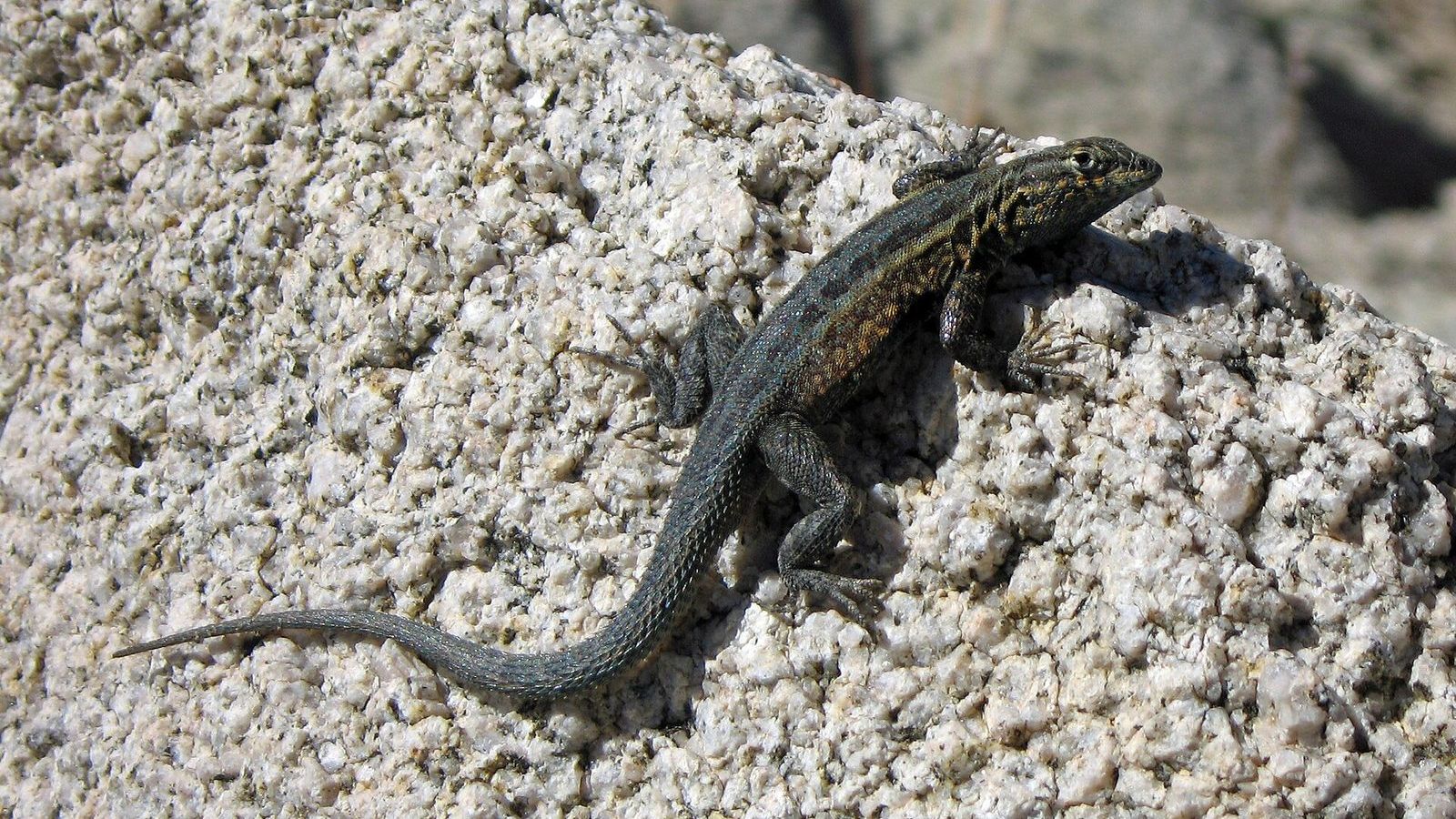
Male side-blotched lizards, Uta stansburiana, come in three throat colours that go with three ways of life. Orange-throated males are large and aggressive and defend big territories containing several females. Blue-throated males are smaller, hold small territories, and guard a single mate closely. Yellow-throated males hold no territory and look like females, which lets them slip past the orange males and mate with females in the large territories. Orange beats blue by taking its territory; yellow beats orange by sneaking; blue beats yellow because a closely guarded female cannot be reached.
Barry Sinervo and Curt Lively followed a population at Los Baños Grandes in California from 1990 onwards and reported in Nature in 1996 that the three types do not settle at fixed proportions. Their frequencies cycle: when orange males are common, yellow males do well and increase; when yellow is common, blue does well; when blue is common, orange does well. The cycle takes a few years to come round, and the paper shows it in the field data. The replicator equation for rock, paper, scissors predicts exactly this, and whether the cycle is a closed loop, spirals inwards towards a stable mix, or spirals outwards towards extinction of one type depends on whether a win is worth more or less than a loss costs. A population under the replicator equation need not go anywhere; it can go round for ever.
Why game theory needed this
Evolutionary game theory removed the assumption that players reason, and in doing so answered a question the rest of the subject had struggled with: how a population arrives at an equilibrium. Selection, imitation, or trial and error can bring a population to a Nash equilibrium that no individual computed, which is one reading of why professional footballers play minimax without solving equations. The same framework explains sex ratios near one half, the honesty of costly signals, and when cooperation can survive among relatives or neighbours. Christoph Hauert's EvoLudo simulations run the hawk-dove game and rock, paper, scissors in the browser, and watching a population return to \(V/C\) after a shock does more for understanding stability than any definition.
Unit 8 of the Game Theory Masterclass solves the hawk-dove game as a two-player game with the indifference condition; Unit 11 reinterprets it for populations, defines the ESS by Maynard Smith's two conditions, proves that an ESS is a Nash equilibrium, reads the replicator equation on the phase line and the triangle, and redraws the lizard data.