 Image: British official photographer, public domain
Why tit for tat won Axelrod's tournaments
In 1979 Robert Axelrod, a political scientist at the University of Michigan, wrote to game theorists in economics, psychology, mathematics, sociology, and political science and asked each of them to send him a computer program. The program would play the prisoner's dilemma against every other entry, 200 rounds per match, with the payoffs 3 for mutual cooperation, 1 for mutual defection, and 5 and 0 when one player defected on a cooperator. The winner would be the program with the highest total score. Fourteen entries arrived, some of them dozens of lines long, and Axelrod added a program that chose at random. The results were published in the Journal of Conflict Resolution in 1980.
The winner was the shortest entry. Anatol Rapoport, a mathematical psychologist in Toronto, had sent four lines: cooperate in the first round, then do whatever the opponent did in the previous round. Tit for tat.
The second tournament
Axelrod then published the full results, explained why tit for tat had won, and ran the tournament again. This time 62 entries arrived from six countries, from professors and from amateurs who had read about the first round in a computer magazine, and every entrant knew that tit for tat had won and could design against it. Several did, with programs that tested whether an opponent could be exploited and defected when it could. The matches had a random length, averaging around 150 rounds, so that no program could defect safely in a known last round.
Tit for tat won again. Axelrod's 1984 book The Evolution of Cooperation tells both stories and draws out what the successful programs had in common. He named four properties. A good strategy was nice: it never defected first. Every one of the top eight entries in the first tournament was nice, and every one of the bottom seven was not. It was retaliatory: it punished a defection at once, so that it could not be exploited for long. It was forgiving: after punishing, it returned to cooperation as soon as the opponent did, so that one defection did not start an endless feud. And it was clear: an opponent could work out quickly what it was dealing with and settle into mutual cooperation.
Why it works, in numbers
Tit for tat never wins a single match. Against any opponent it scores at most what the opponent scores, since it defects only after being defected on and so can never get ahead. It won the tournament because it did well against everybody while the clever programs did well against some and badly against others. A strategy that exploits always cooperate by 5 points a round loses 2 points a round against a retaliator, and in a tournament the retaliators were in the majority.
The theory behind this is the theory of repeated games, and the central number is how much a player cares about the future. Write \(\delta\) for the weight a player puts on next round's payoff relative to this round's, or equivalently for the probability that the game continues for another round. A player facing a retaliatory opponent who considers defecting once gains \(T - R = 2\) this round and then loses \(R - P = 2\) in every future round of punishment. Against grim trigger, which punishes for ever, defection does not pay if
\[ \delta \;\geq\; \frac{T - R}{T - P} = \frac{5 - 3}{5 - 1} = \frac{1}{2}. \]So with Axelrod's payoffs cooperation can be sustained as soon as next round counts at least half as much as this one. Tit for tat has to pass a second test, against an opponent who alternates defection and cooperation to lure it into a cycle, and that gives \(\delta \geq (T - R)/(R - S) = 2/3\). With 200 rounds and no discounting both conditions hold easily, which is why nice strategies did well. The Axelrod library, a free Python project, contains more than 230 strategies from the literature and lets you rerun both tournaments in a few lines.
The trenches of 1914
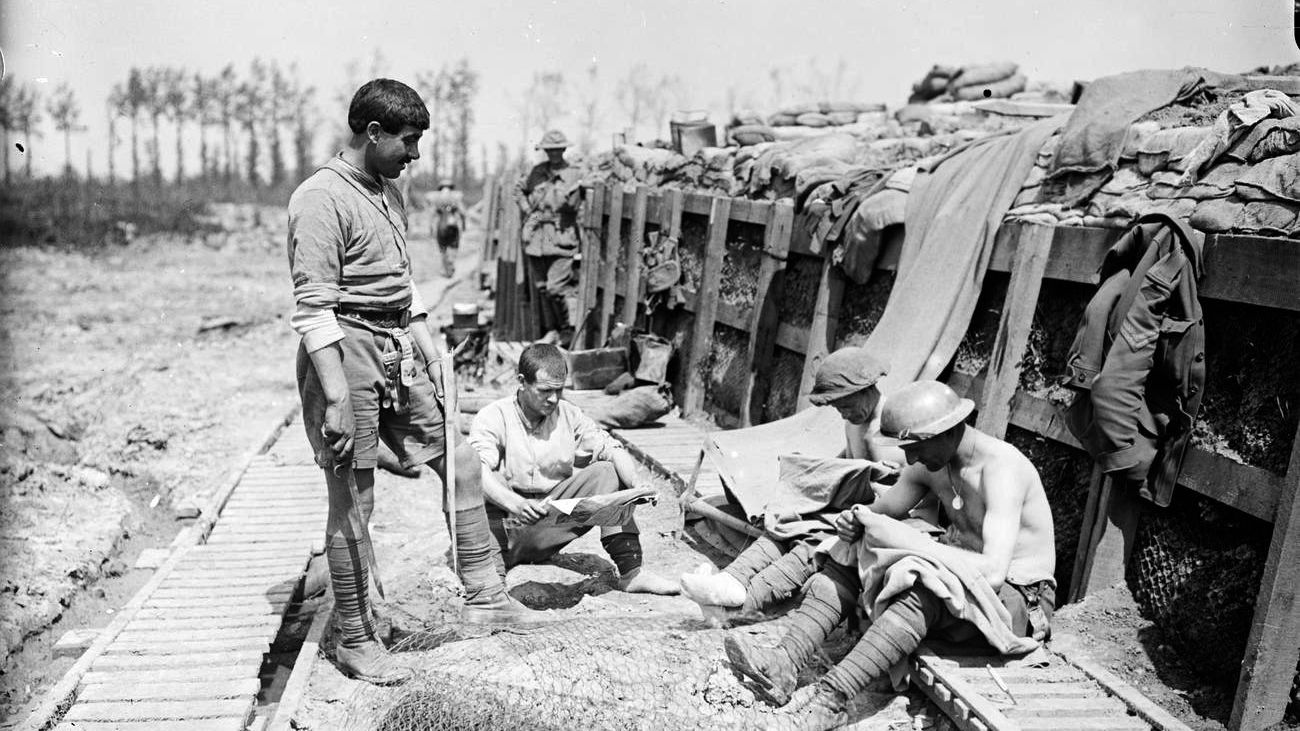
Axelrod's most-cited chapter is about a case with no computers. On the Western Front in the winter of 1914 and 1915, units facing each other across a few hundred metres of mud settled into what soldiers called live and let live: artillery fired at the same time each day and at the same empty ground, snipers aimed high, raids were announced by noise. Tony Ashworth's history of 1980, on which Axelrod draws, documents the system from letters and regimental records. The structure fits: the same units faced each other for weeks, every day was another round, a shot that killed invited a shot back, and both sides understood the arrangement without a word being exchanged. The high command broke it by ordering raids that forced retaliation and by rotating units so that the game stopped being repeated. The point is not that soldiers read game theory; it is that a repeated game with patient players produces cooperation whether or not anyone intends it.
Where tit for tat loses
The strategy has a weakness that the tournaments, with perfect execution of every move, did not show. Suppose moves are sometimes made by mistake: a player who meant to cooperate defects one time in twenty. Two tit for tat players who have been cooperating happily then fall into alternating punishment, each defecting because the other just did, and the cycle continues until a second mistake either ends it or makes it worse. Grim trigger does worse still: one mistake and both players defect for ever.
Martin Nowak and Karl Sigmund showed in 1992 that in a population with noise a more forgiving rule does better: generous tit for tat, which answers a defection with cooperation some of the time, roughly a third with these payoffs. A year later they found that an even simpler rule, win-stay lose-shift (repeat your last move if it earned you 3 or 5, change it if it earned you 1 or 0), could invade and displace tit for tat in such a population, because it can correct a mistake in a single round and also exploits unconditional cooperators. The lesson of the tournaments survives with a footnote: be nice, retaliate, forgive, and be clear, and in a noisy world forgive a little more.
What the theory does and does not promise
The result that patient players can sustain cooperation in a repeated prisoner's dilemma is called the folk theorem, and it is important to read it correctly. It says that cooperation is an equilibrium when players are patient enough, not that it is the equilibrium; mutual defection in every round remains an equilibrium too, and so do many ugly mixtures. The theorem is about possibility. Which equilibrium real players settle on is an empirical question, and laboratory experiments since the 2000s, notably by Pedro Dal Bó and Guillaume Fréchette, show that people cooperate more when the continuation probability is high enough to make cooperation an equilibrium, and more still when cooperation is also the less risky choice, but that being an equilibrium on its own is not enough.
Unit 6 of the Game Theory Masterclass derives the critical discount factors for grim trigger and tit for tat by the one-deviation check, states the folk theorem with its hypotheses, and computes a five-round tournament by hand before handing you the library to run a large one.