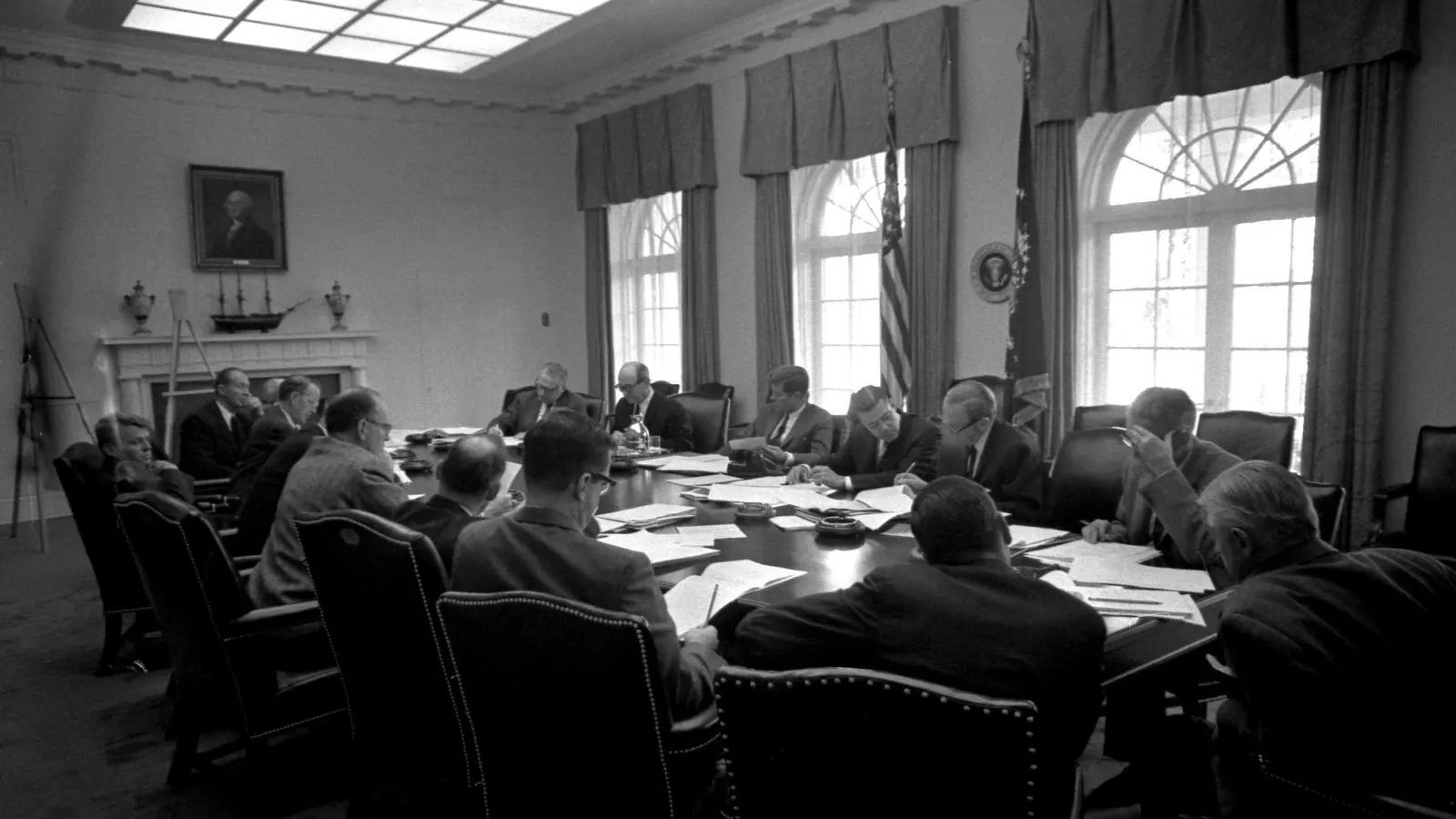
 Image: Cecil Stoughton, White House, public domain
What the Cuban missile crisis taught game theorists
On the morning of 16 October 1962 President Kennedy was shown photographs, taken by a U-2 aircraft two days earlier, of Soviet medium-range missile sites under construction in Cuba. On 22 October he announced on television a naval quarantine of the island and demanded the missiles' removal. On 24 October the quarantine took effect and Soviet ships stopped short of it. On 27 October a U-2 was shot down over Cuba and its pilot killed. On 28 October Radio Moscow broadcast Khrushchev's agreement to dismantle the sites, in exchange for a public American pledge not to invade Cuba and a private one to remove American missiles from Turkey. Those are the thirteen days, as historians count them, and they are the episode game theorists have returned to more than any other.
Schelling before the crisis
Thomas Schelling, an economist at Harvard who had worked on the Marshall Plan and at RAND, had published The Strategy of Conflict in 1960, two years before the crisis. The book is about bargaining in which the parties have a shared interest in avoiding the worst outcome and conflicting interests about everything else, which is most bargaining, and it contains three ideas that the crisis would be read through.
The first is commitment. In a game where players move in sequence, the power to limit your own options can be an advantage. A driver in a game of chicken who visibly throws away the steering wheel wins, because the other driver now knows that swerving is her only choice. A general who burns the bridge behind his army makes the threat to stand and fight believable, because retreat has been made impossible. In the language that Reinhard Selten would formalize five years later, a threat is credible only if carrying it out would be the best move at the moment it is called, and commitment devices work by changing what the best move at that moment is.
The second is the threat that leaves something to chance. A threat to start a nuclear war in response to a provocation is not credible, because starting one would be catastrophic for the threatener too. A threat to take steps that raise the risk of war, in a situation that neither side fully controls, can be credible, because each step is small and the risk is real. Schelling called the resulting contest brinkmanship: the manipulation of a shared risk of disaster, in which the side more willing to bear the risk prevails.
The third is the focal point: when two parties must agree on something without communicating, they converge on whatever stands out. A quarantine line at sea, a demand for removal of the missiles and nothing more, a deadline tied to the moment the sites would become operational, all served as focal points that let both sides understand what was being asked.
The crisis through the tree
The simplest model is chicken. Each side can press on or back down. If both press on, war. If one backs down, it loses face and the other gains. If both back down, a compromise. Chicken has two equilibria in pure strategies, one in which each side backs down while the other presses on, and the question is which one is played. Commitment answers it: the side that can convince the other that it will not back down gets its preferred equilibrium.
Read this way, the quarantine was a commitment device. It was a public step, announced to the world, from which retreat would have been visible and costly, and it put the next move in Soviet hands: ships would either stop or be stopped. The shooting down of the U-2 on 27 October was the kind of event that leaves something to chance. The American pledge not to invade gave the Soviet side a way to back down that could be presented as a gain. And the secret part of the deal, the missiles in Turkey, let both leaders tell their own audiences that they had not backed down at all, which is what a focal compromise looks like when face matters.
Schelling's second book, Arms and Influence of 1966, draws on the crisis directly, and his Nobel prize of 2005, shared with Robert Aumann, cited the understanding of conflict and cooperation through game theory.
Where the tree stops fitting
A game tree assumes players who are single decision makers, who know the tree, and who choose. Graham Allison's Essence of Decision of 1971, the standard study of the crisis, argued that this is one of three ways to read it, and often the least accurate. The quarantine's position was moved by the Navy; the U-2 was shot down by a local commander without orders from Moscow; a second U-2 strayed into Soviet airspace the same day by navigational error; and the American missiles in Turkey that Kennedy traded away were ones he believed he had already ordered removed. Organizations follow routines, and leaders bargain with their own advisers as much as with the other side. None of this fits in a tree with two players.
The honest conclusion is the one Schelling himself drew: the game-theoretic reading is about the structure of the situation and the logic of threats within it, not a prediction of what particular men would do on particular days. The structure was real. Both sides did have a shared interest in avoiding war and opposed interests in the outcome; commitments did matter; the risk of accident was the central fact of the final weekend. What the tree cannot do is tell you whether a given leader will understand all this, or whether the people carrying out his orders will do what the tree says he chose.
What the episode left behind
Three things in the vocabulary of game theory come from these years and this case. The distinction between a credible and an empty threat, which Selten's subgame perfect equilibrium made precise in 1965 and which Unit 5 of the masterclass teaches on the entry game. The idea that a player can gain by giving up options, which runs through bargaining theory, contract design, and the economics of reputation. And a lasting caution about the gap between the cleanliness of a tree and the untidiness of the organizations that act in it. The masterclass presents the crisis through the dates above and the published accounts, and takes no view on what either government should have done.
Unit 5 of the Game Theory Masterclass introduces backward induction, subgame perfection, and commitment, tells the thirteen days as an excursion, and marks where the game tree stops being a good description of the episode.