
History of game theory
The people and dates behind the theorems: Zermelo's theorem of 1913, Nash's 27 pages of 1950, the thirteen days of October 1962, and the book of 1944. Each article follows one episode: the endgame tablebases, what Schelling made of the missile crisis, and the science that von Neumann and Morgenstern announced.
Articles
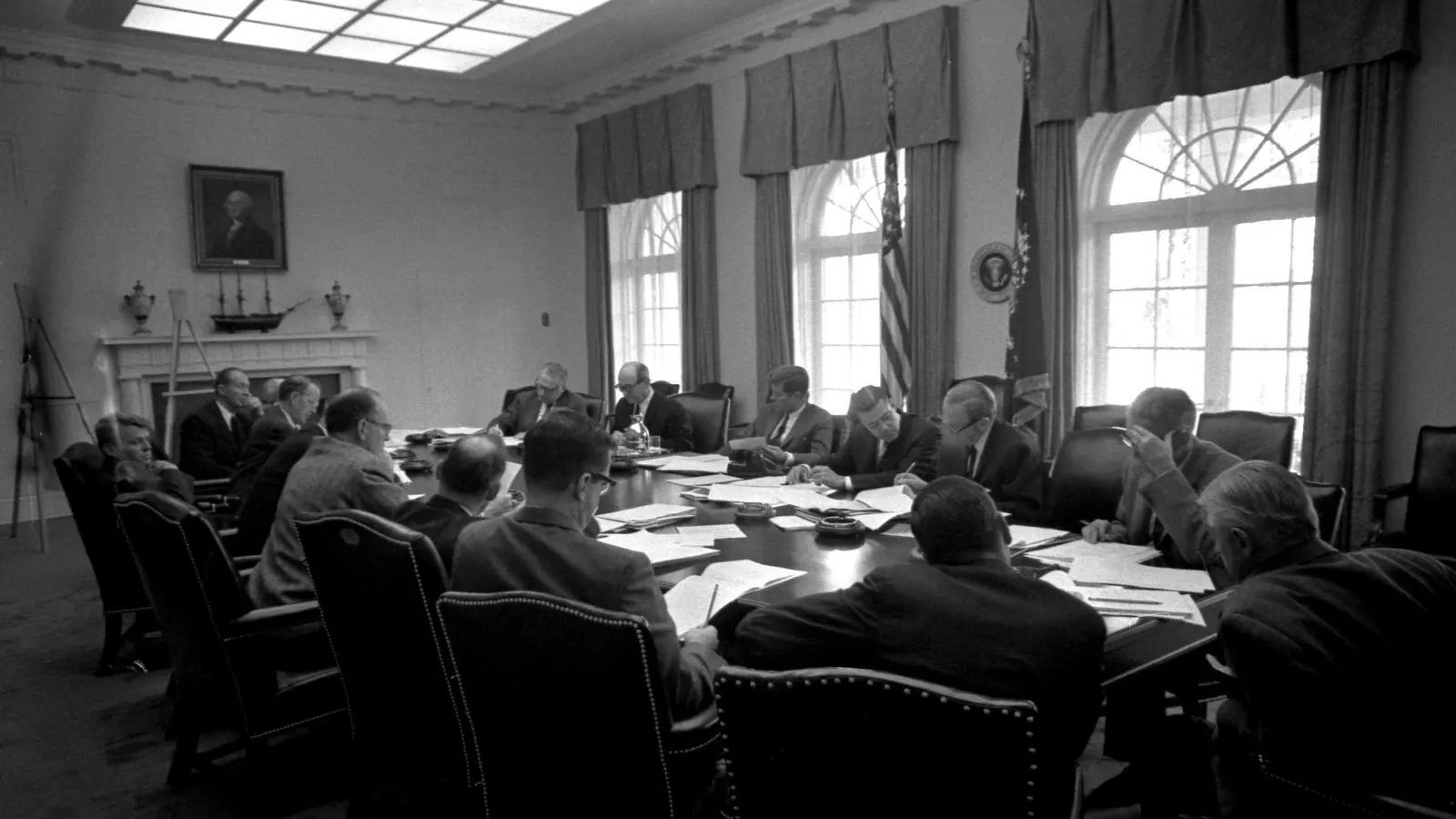
What the Cuban missile crisis taught game theorists
Thirteen days in October 1962 became the standard example of commitment, credible threats, and the threat that leaves something to chance. Here is what Thomas Schelling made of them and where the game tree stops fitting.

Nash's 27 pages
John Nash's Princeton thesis of 1950 defined the equilibrium that every game theorist now uses and proved that every finite game has one. What the definition says, in plain words, and why it took decades to matter.

Chess has a value, and nobody knows it
In 1913 Ernst Zermelo proved that chess is either a forced win for White, a forced win for Black, or a forced draw. More than a century later the answer is known only for positions with seven pieces or fewer.

Why both prisoners confess
The prisoner's dilemma written out with its payoffs, why confessing is a dominant strategy, what the experiment of January 1950 really showed, and what has to change before two players can cooperate.
In the masterclass
Players, Strategies, and Payoffs
The language every later unit uses, from the payoff matrix to the best response
Nash Equilibrium
A profile of strategies in which nobody wants to change their mind
Game Trees and Backward Induction
Sequential moves, credible and empty threats, and the equilibrium that survives them